
Accelerating Sales Expertise in MedTech: Insights from the Brussels Roundtable

Training the Complexity and Reading the Room

Developing sales expertise is no longer about memorizing scripts — it’s about thinking in context. As André Brauers from Zeiss Medical Technology noted, “We’re moving from product selling to workflow solution selling. It requires new mindsets and skills that go beyond technical knowledge.”

This shift reflects the transition from simple product promotion to managing ecosystems of decision-makers. Tanja Feldmueller of Ulrich Medical added, “Our sales reps used to focus on one surgeon. Now they have to deal with procurement, hygiene, and reimbursement teams — often all at once. That’s a completely different job.”

Hugo Cardoso from Abbott summarized the practical challenge: “We need consistency across countries but flexibility for local realities. Account management doesn’t mean the same in Germany as in Norway — yet the core skills must remain scalable.”

This comment resonated with everyone: training must balance structure and adaptability — just like effective sales strategies.

The challenges raised by our participants align with what research tells us about how expertise actually develops and with the real-world challenges. Elena Ciani our Head of Neuroscience – who works at SkillGym’s methodology- explained the principle behind this challenge: “Expertise forms when people practice complex skills repeatedly from different perspectives. That’s how they build automaticity and flexibility — the true marks of mastery.”

As supported by the Accelerated Expertise framework (Crandall et al., 2006; Fade & Klein, 2010), experts build expertise by encountering the same situations repeatedly from different angles — this depth of exposure and experience enables them to handle familiar situations quickly and effortlessly and navigate new or tricky situations with confidence.

This is why, at Skillgym, we designed “Circuits” — a dynamic set of scenarios that allow to practice the same set of skills from multiple perspective. A pricing negotiation Circuit, for instance, might first involve a cost-conscious buyer, then a value-focused executive, then a committee decision — same core situation, different dynamics. This forces trainees to adapt their approach rather than memorize scripts, building expert-level pattern recognition and adaptive problem-solving in weeks instead of years.

Practicing and learning with this kind of complexity and flexibility allows sales reps to develop not only technical fluency but also the pattern recognition needed to “read the room” effectively — exactly what Cardoso, Brauers, and Padmanther were calling for.

Rejection Resilience and Tolerance to Frustration

Every participant agreed: sales excellence requires emotional strength. Michael Faje, an experienced training leader, pointed out that, “Many technical experts turned sales reps struggle because they’re not used to rejection. They move from being ‘the good guy’ in hospitals to facing constant no’s — and that can break them.”

Even though there was a certain skepticism about the ability to train some skills, like emotional strength,“Tolerance to frustration can be trained” Elena Ciani connected this idea to psychology: “Frustration tolerance is tied to self-efficacy — the belief in one’s ability to succeed. When people believe they can handle challenges, frustration drops. When they doubt themselves, it grows.”

Her view echoes Albert Bandura’s theory of self-efficacy (1977, 1997, 1986): mastery experiences are the strongest way to boost confidence. In training, this means replicating real challenges and providing constructive feedback to help participants feel progress.

Paolo Gentileschi from Edwards built on this: “Discipline often precedes motivation. You may not feel like going to the gym, but if you start and see results, motivation follows. It’s the same for learning — structure and follow-up help people keep going.”

In Skillgym’s approach, simulated rejection moments are designed to strengthen emotional regulation through repetition and debrief. Immediate multi-layer feedback — emotional, qualitative, quantitative — helps trainees understand both what they did and how they felt. Over time, this fosters resilience, self-awareness, and emotional intelligence — all critical ingredients of sustainable high performance.

Passion-Driven Performance and Cultural Consistency

As the conversation progressed, Edwin Simons from Teleflex reminded us of something fundamental: “Passion makes the difference. It’s what keeps people pushing when everything else fails.”

We explored how organizational culture shapes that passion. Tanja Feldmueller reflected, “People don’t leave companies; they leave managers. To keep a positive mindset, culture must support learning and openness — especially in times of regulatory pressure.”

Consistency emerged as a shared theme. Cultural values, when turned into measurable, actionable behaviors, become the true drivers of performance. Elena Ciani summarized this link elegantly: “Self-efficacy grows in the right environment. If you only get negative feedback, confidence collapses. Culture must sustain people’s sense of capability.”

This aligns with the principles of Cognitive Transformation Theory (Klein & Baxter, 2009): when learners connect purpose, practice, and positive feedback, they internalize excellence as identity, not as instruction.

At Skillgym, we often say “Methodology eats technology for breakfast.” AI and digital tools can accelerate learning, but without a solid human-centered, neuroscience-grounded methodology, technology alone doesn’t create behavioral change. Passion, culture, and lived consistency do.

Conclusions


The Brussels roundtable made one thing clear: sales excellence in MedTech can be accelerated — not by shortcuts, but by smarter, more human training.

By combining cognitive science, emotional intelligence, and practice-based learning, organizations can transform performance and identity alike.

As a company operating for nearly two decades in this field, our belief is unwavering:

Invest in people. Strengthen their self-efficacy. Help them practice complex conversations safely.

When training reflects reality — and culture reinforces growth — strategic account management becomes not just a skill, but part of who people are.

References

  • Bandura, A. (1977). Self-efficacy: Toward a unifying theory of behavioral change. Psychological Review, 84(2), 191–215.
  • Bandura, A. (1986). Social foundations of thought and action: A social cognitive theory. Englewood Cliffs, NJ: Prentice-Hall.
  • Bandura, A. (1997). Self-efficacy: The exercise of control. New York: W.H. Freeman.
  • Crandall, B., Klein, G., & Hoffman, R. (2006). Working Minds: A Practitioner’s Guide to Cognitive Task Analysis. MIT Press.
  • Fadde, P. J., & Klein, G. A. (2010). Deliberate performance: Accelerating expertise in natural settings. Performance Improvement Quarterly, 23(1), 7–24.
  • Klein, G. (1998). Sources of power: How people make decisions. MIT Press.
  • Klein, G., & Baxter, H. C. (2009). Cognitive transformation theory: Contrasting cognitive and behavioral learning. In The PSI Handbook of Service Delivery (pp. 139–160). Wiley.
  • Noon, C., & Hallbeck, L. (2001). Time, productivity and ergonomics in the kitchen and beyond: Vol. 1. Learning, Requirements, and Metrics. Nokomis, FL.
  • Renkl, A., Mandl, H., & Gruber, H. (1996). Inert knowledge: Analyses and remedies. Educational Psychologist, 31(2), 115–121.
  • Schwartz, D. L., Bransford, J. D., & Sears, D. (2005). Efficiency and innovation in transfer. In Transfer of Learning from a Modern Multidisciplinary Perspective (pp. 1–51). Information Age Publishing.

Leave a Reply

What is Conversational Leadership and How Can it Improve Team Performance


Let’s start from the basics: Leaders need followers. Leadership is one of those qualities that only exist through an external recognition.

You can be a great cook even if nobody ever tasted your perfect beef Wellington, or an excellent guitarist even if no living soul ever had the privilege of listening to your cover of the Bohemian Rhapsody solo.

But when it comes to put into practice leadership skills, the only way is to interact with other people and make them observe and judge our attitude and skills in this field. A Leader must communicate; to talk with the others and to let his words drive his followers towards a common direction.


But now we have to move a step forward: In a complex, hyperconnected world, communicating is not enough. A Leader can’t just spread his vision to his followers with impersonal, unidirectional broadcast messages.

If he wants to generate a lasting and positive change, he’d need to involve people in a more democratic, empathetic and engaging form of human interaction: face-to-face conversations.


Conversational Leadership is not an option

It is not only a matter of self-improving in communication skills, managing an effective conversation is something that every Leader should be able to do. His organization asks him to it. His team asks him to do it (explicitly, if he’s lucky; between the lines, in most cases).

He needs to do it in order to be recognized by his community. Because leadership is not a medal that someone can pin on his own chest.
And most of all, leadership is not effective if it doesn’t spread a positive energy, capable of generating new Leaders in turn.

Here we understand why Conversational Leadership is not an option. A true Leader has to use the transformative power of face-to-face conversations in his everyday work to build connections, influence, encourage people and learn from them.


The aim of a person using a Conversational Leadership approach is not to establish himself as the top of a hierarchical pyramid, but to involve the whole group in a self-sustaining empowering process.

According to educator Carolyn Baldwin, “Conversational Leadership is a core process to cultivate the collective intelligence needed to create business and social value”. As a core process, Conversational Leadership is the center of an empowerment strategy.

How is going so far, is this article helpful?

Contact us to discover our
Conversational Leadership training program
leveraging Digital Role Plays
or continue reading the article

Let’s take a more detailed look at the directions they can take to generate such an innovative effect.


Conversational Leadership is a core process to cultivate the collective intelligence needed to create business and social value.


The areas of conversational empowerment

As with other Authentic Leadership models, Conversational Leadership revolves around self-awareness, transparency, ethics, and a balanced relationship.

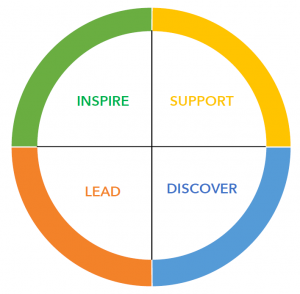
With that as a basis, the conversations proposed by the Leader can involve the following areas of empowerment:

  • Inspire
  • Support
  • Lead
  • Discover


These are the crucial areas where a conversation can really make the difference, as they reflect the needs we all expect to be fulfilled by our Leader. If we ask an employee to complete the following sentence with one word: “I would really like my boss to be more…”, you can be certain he will answer with a word related to one of these areas.

Imagine the four areas of empowerment as the compass rose on a map: every conversation can move towards one of these areas, depending on the leadership style, the counterpart’s needs and the goal of the conversation.


Let’s take a look at them one by one.


  • We need to be inspiring to be motivated thus encouraging collaboration to achieve better results. The power of an inspiring conversation is very easy to understand if we think about great revolutionary minds who shared their visions with such high effectiveness that people perceived the visions as their own (just think about a man who once said “I have a dream…”).
    Leading an inspiring conversation requires the bravery to risk failure by contaminating the counterpart with our innovative vision and the level of credibility that allows us not to fail in the process.


  • Being supportive means being able to help people find their own way to build a path to empowerment.
    A supportive attitude is typical of the coaching leadership style: according to Goleman, this style focuses on developing people for the future by joining the development of individual goals with the long-term goals of an organization’s success.


  • Complementary to the support component, the lead component allows for full empowerment when we’re able to give our counterpart clear direction while conveying that we expect full compliance from him.
    Managing a leadership conversation involving this component requires that the Leader appear clear and intellectually honest to be effective in the eyes of the counterpart. Why would someone comply with the directives if they’re confused and if they don’t trust the person who gave them?


  • The discovery component makes the stimulating and democratic potential of Conversational Leadership very clear. We grow and improve through confrontation with different ideas.
    There’s a treasure inside the experiences we never made and the points of view we never considered before.
    A good Leader is well aware of this, which is why he listens to people and he constantly learns from them.

What do you think about
the four Areas of Empowerment?

Contact us to experience how we support them with
AI-Digital Role Plays here at SkillGym
or continue reading the article

Types of conversations

Each of the four empowering areas implies different possible types of leadership conversations.
A leadership conversation belonging to the Inspire quadrant should be aimed at generating a mesmerizing sense of improvement, always with regard to the company’s unique context and culture. It could revolve, for example, around building trust among the team or motivating people and making them willing to aim for continuous improvement.


A Supportive Leader attempts to reduce employee stress and frustration in the workplace. Therefore, the typical conversations in the Support area could be around easing change, helping to solve conflicts or nudging towards better choices.
This can imply being able to remove those obstacles that prevent people from successfully doing their job, or even building and maintaining good relationships with peers and employees.

The Discover area boils down to creating a deeper understanding of the unique needs of self and others. It may involve conversations about onboarding a new colleague, exploring new possible strategic approaches with the counterpart or aligning someone with the corporate values and behavioral model.

The Lead area is involved when it comes to managing negotiations or delegating a task, for instance. To fulfill the objective in the first case, the Conversational Leader has to fairly represent his own interest(s) and manage the objections of the counterpart.
In the latter case, the objective is achieved by assigning a task with clear directions and providing all information needed to move ahead.


Teams need Conversational Leaders

At this point, it may appear even clearer why Conversational Leadership is not an option. Imagine a team whose Leader is not able to have a crucial face-to-face conversation with each of their members concerning these areas of improvement.

An inspiring conversation can foster the motivation of the collaborators, sharpen their sense of purpose and boost great results and team spirit. If the Leader is underperforming in this area, the team will always remain just a bunch of individuals without a common vision about the objective, the values and the sense of their work.


At the same time, let’s imagine the consequences of a Leader unable to support collaborators to ease their daily work and to generate a better workplace. A non-supportive Leader doesn’t make those crucial conversations that help in discovering the reciprocal self, highlighting needs and clarifying contexts, to make better decisions.

When underperforming in the Lead area, the team complains of a lack of conversations conveying the right message to drive them. And simply, things don’t happen.


There are several reasons to explain such power of conversations. Advanced research is increasing proving neuroscience to be the root.

According to William R. Reddy, there is a deep and inextricable link between the emotional process and the cognitive process. Concept learning takes place automatically when the subject associates an emotion.

A state of profound empathy with the counterpart, therefore, acts as a powerful accelerator of the message, since cognitive learning is accompanied by a deeper level, namely emotional learning. Emotions act at the neuronal level and facilitate the processes of knowledge, but there are two other clear pieces of evidence brought forth by neuroscience.


The first is that repetition stimulates the automation of emotional learning. Furthermore, emotions can also be easily induced.
In front of the image of a happy person, subjects are more likely to claim to be happy.

That’s why Conversational Leadership is the best way to generate positive energy and boost employees’ sense of purpose. The empowering energy of the Leader is empathically transferred to his counterpart; and the more the conversation is recurrent, the more its positive effect will last over time and will stimulate the intellectual and emotional activity of the team.


Making the whole team succeed

It’s clear that Leaders need to understand their organization. And this can’t be done if they don’t talk to the people on their team, build connections and share a purpose with them. Conversational Leadership is the most efficient way to pursue these objectives, as it places the Leader at the center of a successful and scalable system.


A performing Conversational Leader encourages and eases the individual improvement of all the people with whom he interacts; and the value of the personal development is priceless for an organization, as self-empowered and motivated people are an example for the others, their positive mindset is shared between the whole group and it becomes a model that is eventually followed by the rest of the team.

The Conversational Leader is the trigger of a chain reaction: he does the first step when he leads, inspires, discovers or supports the others, but the effects of his actions don’t stop with the conversation. The counterpart who’s involved in an effective leadership conversation learns from it, he endorses the transmitted values and he propagates them among the rest of the team.


A long-term impact

Psychologist Richard Boyatzis once conducted an experiment during a study on the impact of the emotional situations generated by significant Leaders on the people who worked with them. These people were asked to identify the key moment when they have felt an “interpersonal synchronicity” with their Leader.

The experiment demonstrated that recalling these moments of full emotional resonance with leaders activated neural circuits in their brains.


In order to unleash all their potential, people do need Leaders able to create intense interpersonal communication. The effects of an empowering leadership conversation are durable, and they are remembered as life-changing key moments, and their mere memory produces mental energy.
And by the way, all of those people who felt such intensive interpersonal synchronicity with their own Leader eventually became executives.

An interesting discovery, isn’t it?

Get in contact to discover how to practice
Empowering Leadership conversations
in a safe environment with AI-Digital Role Plays
or continue reading the article

A system of empowerment

The bad news? All of that is not easy, and it cannot be improvised.
Managing a conversation able to engage and motivate others is hard and it requires a high level of confidence. This is why this kind of conversations are perceived as “Critical”: if we do not practice enough to gain real confidence, they are out of our comfort zone, thus requiring much more effort to perform.

We may know what our objective is, but once we start talking with our counterpart, we feel uncomfortable, our phrases are not clear, the arguments slip our mind and the effectiveness of a conversation that was supposed to be crucial increases dramatically until it becomes useful or even damaging.


The good news? There is a clear pattern to follow to turn this kind of conversations from critical into empowering.
And of course, practice is the key. The more we train, the more our confidence arises.

You can be absolutely sure that Conversational Leadership can’t be episodic; it has to be seeded and constantly nurtured within the whole organization. It has to become viral and grow following an abundance approach.

When everyone is able and confident having these conversations, a leadership mindset will become an intrinsic quality of your team, leading to a long-term improvement of creative thinking, openness and innovation.


What’s next?

Well, this was just an initial overview of a huge and amazing subject. Following is a basic bibliography and a list of articles for further details.

Would you like to know how to get practice and improve in Conversational Leadership?
Don’t hesitate to take some time to read this article (“How to Support the People Development Programs with Artificial Intelligence”) or to book a 1-hour discovery call here. We would be pleased to get in touch with you and continue this conversation.

Let’s change the world together, one conversation at a time!


BIBLIOGRAPHY

1. Avolio, B.J. and Gardner, W. L. (2005). Authentic Leadership Development: Getting to the Root of Positive Forms of Leadership. In The Leadership Quarterly, 16, pp. 315-338.
2. Gehrke, B. and Claes, M. (2013). Global Leadership Practices. New York: Palgrave Macmillan.
3. Boyatzis, M. (2012). Neuroscience and the Link Between Inspirational Leadership and Resonant Relationships. Retrieved from here
4. Gurteen, D. Conversational Leadership. Retrieved from here
5. Hurley, T. and Brown, J. (2009). Conversational Leadership: Thinking Together for a Change. Retrieved from here
6. Goleman, D. (1995). Emotional Intelligence. New York: Bantam Book.
7. Groysberg, B. and Slind, M. (2012). Leadership is a Conversation. Retrieved from here
8. Patterson, K. and Grenny, J. (2011). Crucial Conversations Tools for Talking When Stakes are High. New York: McGraw-Hill Education.
9. Reddy, W. M. (2001). The Navigation of Feeling: A Framework for the History of Emotions. Cambridge: Cambridge University Press.
10. Scarcity or Abundance in Leadership? (2018). Thrive Global. Retrieved from here

Leave a Reply